Wednesday, November 01, 2006
Some of Hargrave's finer selling points
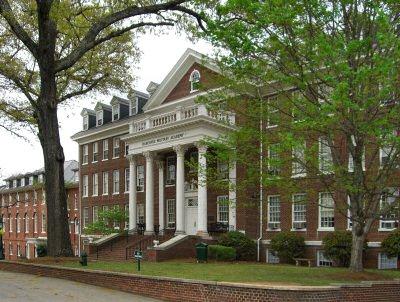
In a sense, Fork Union fit more closely the "image" of a traditional military academy. Hargrave looked more like a grand university, with its majestic four-columned main building. Hargrave looked less somber than Fork Union; it appeared more "big league" to my father. For some reason, my father also felt that the cadets looked sharper than those at Fork Union. Who knows what exactly he saw. Perhaps he happened to catch cadets at Fork Union at a down time when most were dressed in gym attire, while we may have visited Hargrave during a formation or during class hours. In any case, my father was better impressed by the manner of dress at HMA.
Then, of course, there was the 'ole statue in front of Cheatham Chapel. That really appealed to my father. He thought it was sharp (... note, the word "sharp" is a staple of my father's vocabulary... look sharp, be sharp, stay sharp!). When my father read the words at the base of the statue... well, he was sold. How does it go?... "I came here a boy. I left a man." Something like that... Huge huge selling point! Never underestimate the power of a statue and an inspirational saying to go with it. Don't know if Fork Union has something comparable.
Lastly, my father liked the name "Hargrave". The name "Fork Union" didn't seem to strike a chord with my father. But "Hargrave" definitely did. Keep in mind that my father's first language is Spanish. He left Honduras in his late-20s to continue his medical studies at the University of Kentucky in Lexington in 1963--the year President Kennedy was shot. He speaks English perfectly well, but occasionally my father misses a detail or subtlety or two.
I am convinced that when he heard the name "Hargrave" spoken, his mind processed "Hard grave". Well, for a macho Latin American man like my father, that was another fine selling point. Any school named "Hard grave" just had to be a no-nonsense institution... and that was where he was going to send his eldest son!
No doubt Fork Union is an excellent military academy, and I probably would have done fine or maybe even better there than at Hargrave. We'll never know. Fact of the matter, I was destined for Hargrave. With such a fine series of selling points, how could it have been otherwise?
Tuesday, October 31, 2006
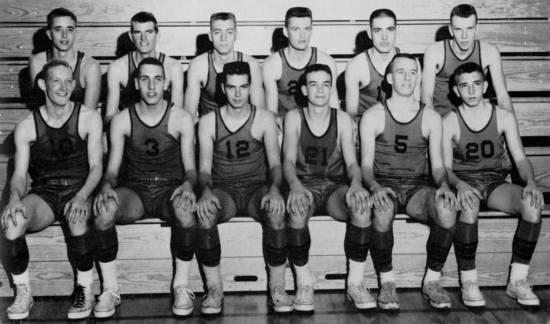
The '61 basketball team
In October 1960 a group of young basketball prospects assembled in Hargrave Military Academy's beautiful new gymnasium to get ready for a tough, twenty-game schedule. No one dreamed that from this group would come, as most people said in the end, the most highly-touted team ever to play at Hargrave. No one could have guessed that by season-end this handful of boys would become the most publicized, the most potent, and the most admired of them all. As the Danville Register and Bee said, “These boys will forever be embellished on Hargrave's athletic roll of honor….”After winning five pre-season games (Halifax, George Washington, Whitmell, and two with Martinsville), the Hargrave Tigers went to John D. Bassett to open the regular season. The Tigers won. On the following night they played the first game ever to be played in Hargrave's new gym against Hampden-Sydney College's freshman team, and broke in the new place with a 91-75 victory.
On a four-day trip through Pennsylvania, the team slipped by Lebanon Valley College's freshman team by two points, took two overtimes to win over a determined Wyoming Seminary prep team, then made it a clean sweep by downing the Susquehanna University freshmen.
Back home, now behind tremendous cadet support, the roundballers beat the Lynchburg College freshmen to make it six wins without a loss.
Now, taking on competition in the military league, in its first year of organized existence, the Tigers met Staunton, easily the toughest assignment in the league. The local courtmen pleased the home crowd with a hard-earned win, 80-71. Next they won from the second best opponent, Greenbriar, as they passed the century mark, 108-80.
In a two-day round-robin at Staunton involving four teams, the undefeated Tigers took on Massanutten and, though having a rough go of it physically, won again. The next night they lost their first and only game for the season. A strong, revenge-seeking [Staunton] Hilltopper crew knocked the HMA team from the ranks of the unbeaten to the convincing tune of 80-58.Getting up from the fall, they showed Augusta the way by a score of 70-51 and then left league play long enough to drop John D. Bassett. Massanutten then forfeited a make-up game, and the Tigers started down tht estretch with a win over Augusta, and an impressive victory over Greenbriar, 110-82, which proved to be the only loss the fighting cadets had suffered at home all season.
Hargrave made it 15 out of 16 with a win over Fork Union, then took an outside team, Hampden-Sydney Frosh, at Death Valley by a score of 85-63. Two wins over Fishburne brought the courtmen to their last regular season game at Fork Union. With a victory there, the winning Tigers ended the season with the most wins and the best record of any team ever to represent Hargrave.
In the military tournament held at HMA (the location of the tournament rotates among the military schools alphabetically) the Hargrave team drew a first-round bye because of being regular season winners. Greenbriar beat Fishburne, Massanutten won over Augusta, and Staunton took Fork Union in routine fashion. In the semi-finals Massanutten gave Staunton a go for it before bowing out, and Hargrave won from Greenbriar to make for the “natural” final pairing.
The consolation game found Massanutten pulling the tourney's only upset over Greenbriar, then … the finals … who would it be? Each [Staunton and Hargrave] had almost identical records; they had split regular season games.
“This was unquestionably Hargrave's finest hour in sports. A capacity crowd, limp after forty minutes of heart-stopping basketball, was on its feet,” for, with the support of the greatest cadet corps ever, and with the help of God, the Tigers had won, 81-79.
-The Cadence, 1961
Thursday, October 26, 2006
Looking for missing classes
The oldest alumnus we have on the Hargrave Alumni Forum is Charles R. White of the Class of 1946. Next is Leon Rue of the Class of 1949 and Edward C. Wiegand of the Class of 1950. We have representatives of many classes since 1950, except for 1951, 1952, 1953, 1955, 1956, 1957, 1958, 1964, 1970, 1974, 1977, 1984, 1985, 1987, 1990, 1994, 1996, 2004 and 2005.If you belong to one of these "missing" classes, please join the forum by sending a blank e-mail to hargravealumni-subscribe@yahoogroups.com ...
Do so also if you belong to the Class of 1948, 1947 or classes before 1946. Do so also if you belong to the classes we already have represented: 1946, 1949, 1950, 1954, 1959, 1960, 1961, 1962, 1963, 1965, 1966, 1967, 1968, 1969, 1971, 1972, 1973, 1975, 1976, 1978, 1979, 1980, 1981, 1982, 1983, 1986, 1988, 1989, 1991, 1992, 1993, 1995, 1997, 1998, 1999, 2000, 2001, 2002, 2003 and 2006.
Walter B. Jones
Congressman Walter Jones [1961 graduate of HMA] tuned his Greenville office television to CNN Thursday morning.Jones' stance on U.S. involvement in that country has garnered headlines for the six-term U.S. representative, who recently broke ranks with many Republicans on Capitol Hill by announcing his impatience with the lack of a concrete plan for withdrawing American forces.
The District 3 congressman from Farmville said his outspokenness about how the country was led into the war, and the conduct of the campaign so far, won't hurt his current re-election bid, where he faces Democrat Craig Weber of Atlantic Beach.
That's because people are becoming aware of arguments made by people such as Greg Newbold, an East Carolina University graduate and retired Marine lieutenant general — "one of the bravest men I have ever known," Jones, 63, said. "He gave up a third star because he saw the lies and the distortion that got us into Iraq."
During an interview at his Greenville district office on Thursday, Jones read from Newbold's article in the April edition of Time magazine titled "Why Iraq Was a Mistake:"
"From 2000 until October 2002, I was a Marine Corps lieutenant general and director of operations for the Joint Chiefs of Staff. After 9/11, I was a witness and therefore a party to the actions that led us to the invasion of Iraq — an unnecessary war," Jones read.
"Inside the military family, I made no secret of my view that the zealots' rationale for war made no sense. And I think I was outspoken enough to make those senior to me uncomfortable. But I now regret that I did not more openly challenge those who were determined to invade a country whose actions were peripheral to the real threat — al-Qaeda."
Jones criticized the Bush administration for its portrayal of Iraq and its weapons of mass destruction program, which formed the basis upon which Jones voted for military action. No WMDs have been found in Iraq. The congressman said the administration misled he and others were, though he stops short of naming Bush among the culprits.
Jones said District 3 voters will understand his position.
Why?
"Because," he said, "the people know that I have made my decision (based) on the research and the investigation" he has conducted, citing his interviews with CIA operatives, a cabinet member's chief of staff, generals and others.
"(Voters) read the newspapers, they see the TV, they understand when people like this are speaking out," he said, tapping on a copy of Newbold's column. "I can never send a person to die for this country unless I know it is absolutely necessary. And when the questions have been coming out for three years now about the justification, was it justified or was it manipulated, I don't know how anyone can say that they want an elected official that does not want to know the truth."
In June 2005, Jones signed a bipartisan resolution urging President Bush to devise a concrete plan for withdrawing troops from Iraq.
"I think people are beginning to understand that ... I want to do what's right based on the facts, not based on the wishes of somebody," he said.
About 70 Pitt and Beaufort County Republicans gave Jones a warm reception Friday night. He was stumping for N.C. House candidate Hood Richardson at a farm between Grimesland and Chocowinity. Jones limited his references to the war to prayers for U.S. soldiers and their families.
Applause punctuated Jones' comments on issues central to his party: lower taxes, gay marriage and illegal immigration.
"I'm more concerned about terrorists coming from Central and South America than I am about terrorists coming from Iraq," he said Friday night.
During the interview Thursday, Jones also touched on the possible effects his campaign may experience due to fellow Republican Rep. Mark Foley's resignation. Foley, of Florida, is being investigated for allegedly sending inappropriate e-mails to teenage pages working on Capitol Hill.
Jones said that controversy wouldn't affect his campaign.
"I hope I'm known for my integrity," he said. "I hope I'm known — whether people agree with me or not — for my moral character. From the very first day I heard about (the Foley case), I said, 'If there's anybody in (the Republican) leadership who has known about this, weeks or months or years ago, then they need to resign.'"
Javier Castillo, chairman of the Pitt County Republican Party, doubted that Iraq or Foley would negatively affect Jones' chances.
"I personally believe not, because Walter has done a great job for his district," Castillo said. Voters may disagree with Jones on that one issue (Iraq), but District 3 voters likely agree with him on most things, and approve of his services in the district, Castillo added.
Richardson echoed Castillo's sentiment on Iraq.
"Republicans don't have to march in lock-step on all the issues," he said.
Johnny Rouse, Pitt County Democratic Party chairman, took the opposite view.
"I think, if anything, it'll hurt him with the core Republican voters," Rouse said. They may choose not to vote at all out of disgruntlement over Jones' criticisms of the Iraq war, he added.
Neither Castillo nor Rouse believed the Foley scandal would affect the incumbent.
"Mark Foley's in Florida, and he's already quit, so that's a problem for electors in Florida, not here," Castillo said.
Rouse said the scandal "may hurt the Republicans' image as the party of quote-unquote values, but I don't think it should affect" Jones. "It would be unfair to paint him" with the actions attributed to his Republican colleague, Rouse said.
By T. Scott Batchelor
sbatchelor@coxnc.com
The Daily Reflector
Tuesday, October 24, 2006
Hargrave in the fall
It is a cool 43 degrees today and windy here in northern Virginia. The leaves on the trees are spectacular in their range of colors. Halloween and Thanksgiving are just around the corner. For some reason, it just feels like Hargrave today. I sense this powerful desire to go find my black jacket.I recall always being cold. There was certainly nothing warm and cozy about the barracks. I can still feel the icey wind blowing through the obviously poorly caulked window in our (... my roommate was Fernando Manrique of Colombia) room. That old radiator (great for drying socks and underwear) beneath our window sometimes gave off sufficient heat and sometimes very little. I guess it depended on how well the boiler was functioning on a given day. Those old standard-issue wool blankets (dark olive color) were adequate, but it took a while to warm up once you slid into bed.
Getting up in the chilly mornings before the sun rose and standing in formation waiting to march to the mess hall for a powdered eggs breakfast certainly didn't give me a toasty feeling either.
Yet, there exists a strange longing in my gut for southern Virginia, Chatham and Hargrave in the fall... cold hallway floors and bathrooms and all.
Monday, September 18, 2006
The Quartermaster's hats
The day before my parents drove me to Hargrave to begin my junior year, I got together with two of my best friends and went out for a drive in the country, in southern Virginia. The primary aim of the outing was to find a barber shop and have a kind of ritualistic hair cutting in preparation for my upcoming two-year "exile" from the world as we teenagers knew it.I had just turned 17 and my hair was nearly down to my shoulders. Deep down inside I always suspected that it was the "hair thing" that was at the root of my father's desire to send me off to military school. Yeah, there was the problem of my poor grades and the looming possibility that I might start to hang out with the wrong crowd in town. But I just knew that that long hair was the true source of the discomfort between me and my father. Hargrave offered the "final solution" to the hair issue.
My friends Richard, Mark and I took off one morning in my family's yellow Chevy Vega and drove toward Lawrenceville, VA. I wanted to take one last look at my old high school, Brunswick Academy, to which I had slowly developed an attachment and a high level of comfort during 10th grade. Brunwick was located down the road from the center of Lawrenceville.
As we drove through town, I noticed a small barber shop. I must have looked at my friends and said something like, "Okay guys, let's get it over with, let's do it." Of course, Richard and Mark were loving every minute of it. Both of them had long hair, and must have felt an element of fear and sorrow for me. However, they were going to milk this moment for all it was worth!
I sat down in the barber's chair, almost as if I were sitting down in the electric chair or laying my head beneath the guillotine. It gave me the shivers. It felt surreal, as if... "This really couldn't be happening to me... I'm going to lose my freedom AND my hair?"
Well, it felt like an eternity. But before long, the deed was done. Three-quarters of my hair was gone... on the floor. I looked like a freek! Short hair. Now, I definitely had to go to military school, because there was no way I could go back to Brunswick like this. I knew somehow it would all work out, but at that precise moment in time it seemed my life was over.
The next morning, we left early for Chatham. My whole family went. My parents, my brothers, my sister. They helped me settle in. My mother took me into town to buy some shelves for my stereo and books. We probably had lunch somewhere... kind of a "last meal" kind of thing. They were gone by late afternoon, and I was left in my room in the B Company barracks... left to ponder my fate and begin making the mental adjustments that I would need to survive and hopefully flourish in my new environment. My first roommate, Mike Miller, came in and introduced himself. We exchanged pleasantries.
Ultimately, B Company was little more than a weigh station, as I ended up in Band. I figured if I had to be in a military school, I would at least have some fun and play drums... not carry a rifle.
The next day, I received instructions for a range of things, I'm sure. At some point that day, I was guided to the quartermaster's shop (in the basement below the mess hall) to get outfitted with everything I would need to look like a cadet. My grey trousers and coat, my white dress trousers, my grey shirts, my white shirts, my black tie, my belt, my black wool jacket, my black shoes, my shoe polish kit, my insignias, and of course... my hat.
I searched around for several minutes for a hat that fit me properly. Must have tried on five or six hats before a kindly gentleman with a tape measure slung dangling around his neck came up and picked one out for me (kind of like the scene in Ollivadner's Wands from the first Harry Potter movie). I tried it on, but the hat was still too small. The quartermaster looked up at me above his glasses, which balanced on the end of his nose. He paused for a second and quickly decided the hat would do... "No, the hat will fit you fine son after you get your hair cut."
What? "But I just got a hair cut!" I thought to myself in disbelief. "You gotta be kidding me."
I quickly resigned myself. After all, to whom would I complain, reason with? I knew from that very moment that things were going to be pretty black and white. All those shades of grey that previously had given me some wiggle room were gone.
The quartermaster's name was Lt Col. John L. Beaver. Col Beaver died on June 1, 1980, a few years after I graduated from Hargrave in 1976.
Col. Beaver was born in Rowan County, North Carolina, June 8, 1915, a son of the late John Alexander Beaver and Florence Beatrice Eagle Beaver. He was a graduate of Wingate College and Elon College, and attended the American University of Shrivenham, England. He was a veteran of the US Army and spent most of his life in Pittsylvania County, teaching at Schoolfield High School and serving as a teacher, coach, and athletic director at Hargrave . At the time of his death, he was the quartermaster at Hargrave.
Tuesday, August 01, 2006
Boots and breeches
I recently bought an old '43 HMA annual and just finished reading it. This was three years before I started at Hargrave Military Academy, but there were some cadets in it that I remembered as they were in Junior School then.The uniform differed a little in that all cadets wore a leather belt with brass or gold plate buckle. The total cost of both belts and buckles was $2.00. They also had a web belt with slide buckle which is what we used in '45.
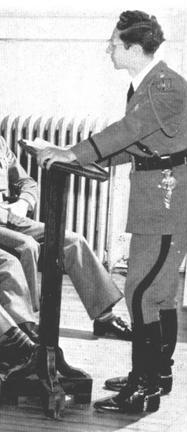
Some of the officers wore riding breeches and high boots and used capes instead of overcoats. The cadets used overcoats with half capes. I had one of these in '45 as my folks could not afford a new overcoat for me. The overcoat was the most expensive part of the uniform. The half cape had a red lining and looked pretty sharp when worn in the open position.
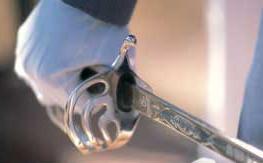
I noticed also that the drum major had a very fancy white uniform and hat with lots of brass buttons.
Smoking was discouraged but allowed to senior school cadets with parental permission but not to any of the Junior school kids.
I noticed that the basketball team had several different jerseys, one of which said "Harris Cleaners".
One of the teachers there was Lt. Col. Thomas Cunningham. He had been an army officer since 1898. He was PSM&T my first year there. He had served in the Philippine Insurection as a calvary officer.
Another familiar face was that of S.P.G. "Jack" Spratt. He had been a lawyer and Customs Agent but married Col. Camden's sister (the school president) no, not the sister, but the Col. was the president. Anyway, I never knew what his real name was until recently I found out it was Samuel Perry Godfrey Spratt.
The track team picture showed the bamboo poles we used for the pole vault. Not much give to those things but better than the aluminum poles. Some of the nicknames were interesting: "Ears","Tiger","Goon","Bugs". "Horse" (Hmmm).
Leon Rue
leonrue@adelphia.net
Class of '49
Annapolis resident is highly decorated in service to his country
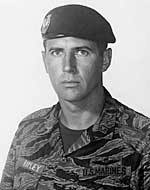
But, there's been no irony in how Marine Col. John W. Ripley has lived a life that has been wilder and more adventurous than any Hollywood action hero. Superman can fold up his cape when Ripley's in the house.
In Vietnam, the Marine rescued the crew of one downed helicopter by loading them onto a second copter. Left behind and wounded, he held off the enemy long enough to extinguish the fire aboard the first copter, and then repair it so it could be flown away.
Months later, under heavy fire on Easter Sunday, 1972, he swung beneath a bridge over several hours, weighted down with his belt and weapon. He packed the bridge's seven steel I-beams with 500 pounds of explosives and, biting gently with his teeth, crimped the percussion caps onto the primer cord. One wrong bite would have blown his skull apart.
He lit the fuse while he was still hand-walking under the bridge.
The Marine would have received the Medal of Honor had a single American witnessed his incredible act of valor. There were plenty of eyewitnesses: two South Vietnamese Marines and, on the opposite shore, 30,000 angry enemy troops.
Col. Ripley's earned a slew of medals, including the Navy Cross, the Silver Star, two awards of the Legion of Merit, two Bronze Stars with Combat "V," a Purple Heart and the Cross of Gallantry. He and one other Marine share the distinction of more combat experience than any other Marine.In the years since, the Marine has fought other battles, on and off the field, and received numerous honors. The Annapolis resident has been a key player in the renovation of the Naval Academy's Memorial Hall. He's also been the creative force behind the new $55 million Marine Corps Museum set to open this fall in Virginia, and he's deeply involved in a Maryland political action group that focuses on veterans affairs.
Last week, on the campus of the Naval Academy Preparatory School, he received a new accolade. He became the rare living Marine to have a building named for him. The school's new barracks, built to house 348 students, was dedicated in honor of the indomitable Col. Ripley, known to many as a Marine's Marine.
"John is an outgoing, larger-than-life person who lives life on the edge," said retired Marine Col. "Iron Mike" Williams. "He's a gentleman but rough and tough when it's required."
The building in Newport, R.I., took years to plan and $14.3 million to build, but only a few minutes to decide whose name should be blazed on the front of the massive three-story building. The large letters spell out "Ripley Hall."
Capt. Charles Hautau, commanding officer of NAPS, recalled a conversation he had last fall with Vice Adm. Rodney Rempt, superintendent of the Naval Academy.
"He was looking for suitable people, NAPS graduates or people in the area to name the building after. It came to light that Col. Ripley is one of our more famous graduates. He's a member of NAPS '58. He hadn't had proper recognition as had other NAPS graduates who'd earned the Navy Cross," Capt. Hautau said.
The school, located in Maryland when Col. Ripley was a student, is a one-year preparatory program for the Naval Academy as well as the Merchant Marine Academy and Coast Guard Academy.
"After Col. Ripley's active duty in Vietnam, he served as an administrator and a teacher," Capt. Hautau said. "He isn't just a warrior's warrior, he's an articulate, well-schooled individual, the balance we look for here."
Impression made
As a young boy, Col. Ripley first encountered Marines in his rural hometown of Radford, Va. Trains packed with Korea-bound enlistees rolled through the town and he'd climb aboard to sell them a nickel newspaper.
The 1957 movie, "Heaven Knows, Mr. Allison," starring Robert Mitchum as a World War II Marine stranded in on a Pacific island with a nun, clinched it for him.
"Holy Cow, that's me," he declared staring at the small town movie screen.
He enlisted in the Marines that year and, shortly after, was selected to attend NAPS. He went on to graduate from the academy in 1962 with a degree in electrical engineering. While there, he set a record on the obstacle course that has stood unbeaten for 44 years.
Trained as a Marine infantry officer, young Lt. Ripley served two tours in Vietnam. During the 1972 North Vietnamese Easter Invasion, the Marine nearly single-handedly destroyed the Dong Ha Bridge.
Marine painter, Col. Charles Waterhouse immortalized the scene in a painting, copies of which hang at NAPS and the Naval Academy. Still, more copies circulate on the internet, fueling the legend.
Author and Marine historian John Grider Miller recounted Col. Ripley's incredible heroism in the book "Bridge At Dong Ha." A deal to turn the book into a movie stalled over a producer's ownership rights and a changing scene in Hollywood.
"With the war in Iraq, Hollywood won't make that movie anytime soon," Mr. Miller said. "But it's a great story. It can wait."
A diorama, "Ripley at the Bridge," has been on display at the entrance to Memorial Hall, inside Bancroft Hall for 21 years.
Recently, Col. Ripley showed it to a visitor. A small figure with a rifle strapped to his back is swinging beneath a bridge with a burning fuse sizzling next to his right ear.
Looking at the miniaturized scene, the colonel exclaimed, "I couldn't believe how big this son of a gun was. FOX-TV took me back to Vietnam to look at it a few months ago."
He pointed out that the bridge had five piers, not the three shown in the diorama. Everything else was accurate, including his filbert-sized helmet, which lay on the ground. He discarded it because it limited his vision.
According to Naval Academy Alumni Association President George P. Watt, Jr., Memorial Hall would not have been restored without Col. Ripley's leadership on the project. During homecoming this fall, the association will dedicate the hall.
"John calls Memorial Hall the Naval Academy sanctus sanctorum - the holiest of holy places. That's where we honor those who've gone before, and, thanks to John, it's been restored to its former dignity and honors those graduates lost in operational line of duty, whether in war or testing an F-14 or aboard the Challenger shuttle. John was the action officer to make that happen. He brought people together."
Academia
After Vietnam, Col. Ripley served with Marine Force Reconnaissance and was an exchange officer with the British Royal Marines in Malaya, and as a commanding officer at the battalion and regimental level.
Eventually, he entered academia, first as a Marine instructor at Oregon State, then the Naval Academy and then commander of the Naval ROTC unit at Virginia Military Institute.
After retiring from the Marines, he was president and chancellor of Southern Virginia University and president of Hargrave Military Academy, before being tapped for director of the Marine Corps History and Museums Division and the Marine Corps Historical Center.
Early in his tenure at Southern Virginia, then an all-female college, he got a late night reception of sorts from a rowdy group of town youth and KeyDets - VMI students who should have known better.
"I could hear 'em out there and some beer cans dropping," he recalled. "I went downstairs and put on some PT gear - running shorts and shirt and some shoes. I got into a position of advantage."
He called the police and informed them of the situation. He told them to put a squad car at the bottom of the hill to block any escape.
"But don't come until I tell you," he said.
"When the police started flashing their light, the guys ran uphill. I hit a guy from the side and rolled him over in a wrestling position, a reverse crucifix," he said.
He realized more men were in the bushes.
"Give up now or I'll come get you," he yelled.
They gave up.
"They were trying to get into the girls' dorm. There would have been worse implications if they'd succeeded."
Women in the military
Col. Ripley's time at Southern Virginia gave him a unique view point of the Navy's acceptance of women. He was part of the administration when the school was sold and switched from an all-female institution to a coed school, an echo of societal changes under way at the Naval Academy.
"The Naval Academy is changing in good ways none of us could have predicted," he said. "The change is reflected in the country and mandates changes in its institutions. I was in the great majority of graduates who were, at first, surprised and shocked when the academy accepted females. When the mission is to produce, combat leaders brought us the issue 'What were we training people for?' "
At the time, women couldn't fly planes or be in combat roles. The Navy accommodated women by removing men. This year, the incoming class is 20 percent women.
"Do we need women? No way this country could accomplish its role and mission without women," the colonel said.
If the Navy acknowledges that it needs women in the service, Col. Ripley sees it as logical to ensure they get trained to the same degree of perfection expected of their male classmates at the academies.
"Those who deny that today, hold a fossilized view of the Academies. Women do as good a job as men - and men do as good a job as women.
"They've earned the doggone right to be here."
Marine Icon
As he sat in Memorial Hall surrounded by plaques bearing names of graduates who died, a docent, former director of admissions Chip Seymour, class of '64, wandered in leading a duckling-line of midshipmen and their parents.
"Col. Ripley!" he said loudly. "Folks, I'm shaking the hand of a genuine hero. This is Col. Ripley. Let me show you what he did in Vietnam."
He led the curious flock away. Left behind, the colonel commented ruefully that it "almost seemed faddish" to heap awards on him.
"There's a whole lot of guys out there who did great things. For heaven's sake, pick one!"
He doesn't take his status lightly.
"You certainly better live up the reputation assigned to you. You don't do anything to cheat them. You must be what they think you are, especially youngsters. No way I'd have done something to discredit my family or the Marine Corps. I'm hyper-aware people are going to look at me and give a valuation to all the things I do."
Col. Ripley has fought incredible personal battles, too. While rescuing 15 wounded or dying soldiers during Vietnam, he was drenched in blood. A few years later, he was diagnosed with Hepatitis B. That, combined with a rare genetic disease, Alpha I Anti-trypsin Deficiency, destroyed his liver.
His first liver transplant in 2002, began to fail within hours. He nearly died before receiving the second liver a few days later from the body of a 16-year-old gunshot victim in Philadelphia.
His sons, Tom and Steve, both former Marines, coordinated the effort to rush the organ and transplant team to his bedside that is worthy of yet another movie about Ripley's life.
Four years later, at 66, the old Marine is in pretty good shape.
He lives with his wife, Moline near the academy. Col. Ripley has another talent: The Warrior can talk baby-talk with the best of them. Friday afternoon, in the kitchen of his elegant Annapolis home, he made chocolate milk for his youngest grandchild, 2-year-old Race. It was his turn to baby-sit the boy.
The colonel's voice took on an Elmer Fudd quality as he pulled out a tiny contraption to blend syrup and milk.
New challenges
At the dedication of Ripley Hall, the retired Marine looked out over the 200 people in the audience and spotted "people I knew 50 years ago."
Several classmates turned out for the dedication, along with a former private from one of the colonel's rifle companies in Vietnam. Among the Navy brass in the audience were Adm. Rempt and the Coast Guard Academy superintendent.
Col. Ripley has received other honors, too. He is the first Marine selected as a Naval Academy Distinguished Graduate. Two years ago, the 22nd Marine Expeditionary Force in Afghanistan named Firebase Ripley in his honor.
He is still busy as a consultant, getting the new museum in Quantico ready for its public debut in November.
"You'll be rocked back on your heels," he said. It's a state-of-the-art wonder."
When Col. Ripley heard the new barracks at NAPS would bear his name, he reminded Superintendent Rempt about Marine tradition: things aren't named for living Marines. If the Marine Corps had been consulted about the building's namesake, it would be denied.
"Sir, this is a Navy building," came the response.
Col. Ripley chuckled. "They didn't ask the Marine Corps."
By Wendy Winters
The Annapolis Capital