Thursday, January 29, 2009

Thursday, November 06, 2008
Col. John Ripley dies

Col. John Ripley was a decorated Marine, a Vietnam war hero, and an educator with strong ties to western Virginia. Ripley died over the weekend at his home in Annapolis, Maryland.
Ripley taught naval science at Virginia Military Institute during the early 90s. When he retired from active duty, he became President of Southern Virginia College in Buena Vista. He would later lead Hargrave Military Academy as well.
Ripley earned the Navy Cross for his service in Vietnam in 1972, when he rigged a bridge with 500 pounds of explosives and stopped an advancing column of North Vietnamese tanks.
Ripley was a native of Radford. He was 69 years old.
Wednesday, January 09, 2008
Col. Todd turns 90
 The Cadets of the 2007/2008 academic year marched proudly to their neighbor's house to wish him a happy 90th birthday on December 5, 2007. The event was a surprise, and their neighbor and former Hargrave president, Col. Andrew Todd, was initially speechless. Mrs. Todd had to work hard to keep Col. Todd in the house for the event. He remains very much on the go.
The band played 'Happy Birthday' and other songs. The Highlanders also had a moment to play, too. At the end of the event, Col. Todd was provided a luxury gift from the Academy.
Col. Todd was impressed with the Corps. But as an expert in raising boys he stated, "It's remarkable how they turn out after 25 years."
Happy Birthday, Col. Todd, from your Hargrave family.
Saturday, February 10, 2007
Camden House
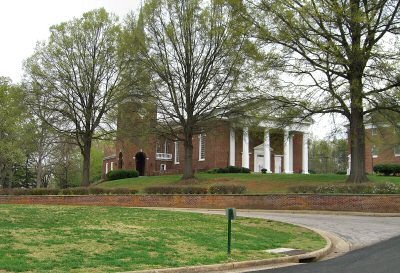
I graduated Class of '69. Col. Cosby was still firmly in charge at the time. My junior year, I was quartered in the Camden House, where the chapel now stands. Richard Abernethy was in charge of the house and it was a great place to stay... except in winter and you wanted to take a shower! That required going around on the back porch into a separate room.
The neat part of the Camden House was the third floor. It was off limits, with a door to the stairway firmly padlocked. Enterprising cadets had gone in the other side, where there was a closet, and loosened the steps, allowing us fairly easy access. There was a balcony of sorts and we had a great time sitting up there, enjoying the view. We were never reported or got caught. I still have a picture somewhere of that balcony.
Mr. MacMillian, who taught theology, lived in a separate part of the house, with his own entrance. Mac was the only person we knew who could walk into the main part of the house without the boards creaking. That was always our tip off during evening study time, when the other teachers made the rounds.
George Fordham
fordhamwv@aol.com
Band Company '69
Enfield rifles
 When I started at HMA in '45, I was issued an Enfield rifle, not a Springfield rifle. Clay Draud thinks I am nuts as
 Later an alumni bought the school rifles to carry. Incidently the Enfields we had originally were operational and that lasted until a cadet obtained ammo and took his out in the woods for a little target practice.
Leon Rue
leonrue@adelphia.net
Band Company '49
Monday, November 06, 2006
Col. Manrique's journey
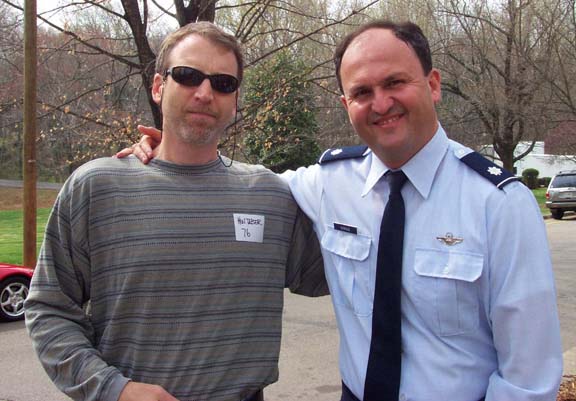 Ken Taber and Col. Fernando Manrique
Being from Colombia and having been sent to Hargrave under rather false pretenses, Fernando always seemed to carry a bit of a grudge toward the concept of military school and the US in general. The military school one is obviously understandable. And so was the grudge against the US, if you happen to look at it from the Latin American perspective... very normal indeed. I didn't carry this feeling with me because I had been raised in the US since I was 4 years of age. Even though I am of Latin American origin, I've always identified more culturally with North America.
The amazing thing is that Fernando ended up pursuing the two things that he most disliked as a teenager... a military life and a career with the US government. He will be the first to admit that both the Air Force and the US have been extremely good to him, and he has no regrets. In fact, he's extremely proud of the uniform he wears and his service career. Fernando ended up marrying a wonderful North American woman, and both of their children are fairly "true blue".
Keep in mind, though, that ideologically and philosophically Fernando hasn't changed all that much... clearly he's infinitely better read, traveled and experienced. He and his family lived in Japan for many years. He still has an extremely independent nature to him and is very outspoken in private. But he has learned (as we all have to some degree) to pick and choose his battles and be smart about it, particularly when it comes to divisive and very emotional issues. One learns and becomes wiser with age, although there often remains an idealistic flame within many of us.
When Fernando and I got together a few months ago, it was as if time had stood still. Were it not for his blue uniform, leather jacket and receding hairline, and a few additional pounds, Fernando is nearly the same person I knew in 1974-76. And that is a good thing because we were able to talk freely and relate. We did not leave our first encounter in more than two decade with the sad thought, "Gosh, what ever happened to the guy I knew?"
After he left HMA, Fernando went on to graduate from the College of William and Mary in Williamsburg, VA. He eventually earned his PhD degree. In a couple of years, he will retire from active duty with his 20 years. He will be returning to live in Colorado, and he told me that his dream post-retirement career would be head of the Languages Department at the US Air Force Academy in Colorado Springs.
Fernando was an extremely intelligent student at Hargrave. Probably the brightest and most capable of the Class of '76. He didn't try very hard, and yet everything came very easy to him and he got excellent grades. Prior to arriving at Hargrave, Fernando had gone to a great British school in Bogota. I don't think Hargrave challenged Fernando much academically, but I do think that the school helped him mature and perhaps knocked his ego down a few notches...
Ego notching down is a Hargrave strength. It is this one thing that probably helped the colonel adjust, survive and prosper in North American society.
Friday, November 03, 2006
Ripley pays tribute to Marines
 The Richmond Council of the Navy League celebrated the Nov. 10 birthday of the U.S. Marine Corps a few days early yesterday with a rousing speech from one of its most decorated members.
Col. John W. Ripley, awarded the Navy Cross and other medals for heroism during the war in Vietnam, talked to about 160 people at the Willow Oaks County Club about toughness, eadership and team work.
Though retired, he made it clear, "Once you're a Marine, you're always a Marine."
Ripley, a native of Radford, graduated from the U.S. Naval Academy in 1962. According to the Navy League, he shares the distinction with one other Marine of having the most combat xperience in the Corps.
In Vietnam, he rescued the crew of one downed helicopter by loading them into another helicopter. On Easter 1972, he swung hand-to-hand under a bridge at Dong Ha for several hours packing the span's steel beams with 500 pounds of explosives so it could be blown up, denying the enemy a way across the river.
"The cheapest way to kill the enemy is to send a Marine with a rifle," Ripley told the appreciative crowd. The Marine, he said, gives the United States the best return on defense dollars.
"Austerity has been a way of life in the Marine Corps. Indeed, it is a religion to us, to be the leanest of services."
Noting the current film about the Corps' flag raising on Iwo Jima, "Flags of Our Fathers," Ripley pointed out that one of the six flag raisers was a U.S. Navy corpsman. At Iwo Jima, said Ripley, he Marines suffered 25,000 casualties out of a force of 75,000. Among them were 300 Navy corpsmen, he said.
Iwo Jima, he said, was the only battle in the history of the Corps where the Marines suffered more casualties than the enemy. "That's because we ran out of enemy," he said, prompting aughter.
"I learned how to adapt well in conditions of misery, exhaustion, sleep deprivation, short rations, grief of loss, staggering heat, biting cold, sustained filth," he said.
Ripley, former president of Southern Virginia College in Buena Vista and Hargrave Military Academy in Chatham, is a former director of the Marine Corps History and Museums Division.
By Frank Green
The Richmond Times-Dispatch
Wednesday, November 01, 2006
Some of Hargrave's finer selling points
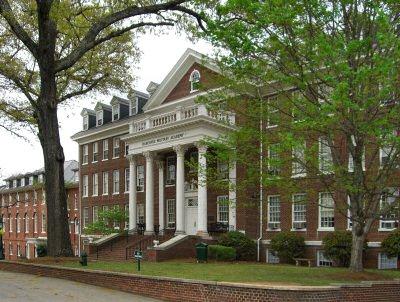 (photo courtesy of Henry H. Mitchell)
In a sense, Fork Union fit more closely the "image" of a traditional military academy. Hargrave looked more like a grand university, with its majestic four-columned main building. Hargrave looked less somber than Fork Union; it appeared more "big league" to my father. For some reason, my father also felt that the cadets looked sharper than those at Fork Union. Who knows what exactly he saw. Perhaps he happened to catch cadets at Fork Union at a down time when most were dressed in gym attire, while we may have visited Hargrave during a formation or during class hours. In any case, my father was better impressed by the manner of dress at HMA.
Then, of course, there was the 'ole statue in front of Cheatham Chapel. That really appealed to my father. He thought it was sharp (... note, the word "sharp" is a staple of my father's vocabulary... look sharp, be sharp, stay sharp!). When my father read the words at the base of the statue... well, he was sold. How does it go?... "I came here a boy. I left a man." Something like that... Huge huge selling point! Never underestimate the power of a statue and an inspirational saying to go with it. Don't know if Fork Union has something comparable.
Lastly, my father liked the name "Hargrave". The name "Fork Union" didn't seem to strike a chord with my father. But "Hargrave" definitely did. Keep in mind that my father's first language is Spanish. He left Honduras in his late-20s to continue his medical studies at the University of Kentucky in Lexington in 1963--the year President Kennedy was shot. He speaks English perfectly well, but occasionally my father misses a detail or subtlety or two.
I am convinced that when he heard the name "Hargrave" spoken, his mind processed "Hard grave". Well, for a macho Latin American man like my father, that was another fine selling point. Any school named "Hard grave" just had to be a no-nonsense institution... and that was where he was going to send his eldest son!
No doubt Fork Union is an excellent military academy, and I probably would have done fine or maybe even better there than at Hargrave. We'll never know. Fact of the matter, I was destined for Hargrave. With such a fine series of selling points, how could it have been otherwise?
