Tuesday, August 01, 2006

Boots and breeches

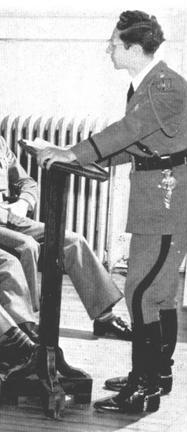
I recently bought an old '43 HMA annual and just finished reading it. This was three years before I started at Hargrave Military Academy, but there were some cadets in it that I remembered as they were in Junior School then.

The uniform differed a little in that all cadets wore a leather belt with brass or gold plate buckle. The total cost of both belts and buckles was $2.00. They also had a web belt with slide buckle which is what we used in '45.

Some of the officers wore riding breeches and high boots and used capes instead of overcoats. The cadets used overcoats with half capes. I had one of these in '45 as my folks could not afford a new overcoat for me. The overcoat was the most expensive part of the uniform. The half cape had a red lining and looked pretty sharp when worn in the open position.

I noticed also that the drum major had a very fancy white uniform and hat with lots of brass buttons.

Smoking was discouraged but allowed to senior school cadets with parental permission but not to any of the Junior school kids.

I noticed that the basketball team had several different jerseys, one of which said "Harris Cleaners".

One of the teachers there was Lt. Col. Thomas Cunningham. He had been an army officer since 1898. He was PSM&T my first year there. He had served in the Philippine Insurection as a calvary officer.

Another familiar face was that of S.P.G. "Jack" Spratt. He had been a lawyer and Customs Agent but married Col. Camden's sister (the school president) no, not the sister, but the Col. was the president. Anyway, I never knew what his real name was until recently I found out it was Samuel Perry Godfrey Spratt.

The track team picture showed the bamboo poles we used for the pole vault. Not much give to those things but better than the aluminum poles. Some of the nicknames were interesting: "Ears","Tiger","Goon","Bugs". "Horse" (Hmmm).

Leon Rue
leonrue@adelphia.net
Class of '49

Annapolis resident is highly decorated in service to his country

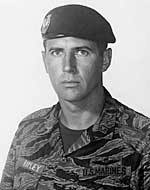
Col. John W. Ripley

There is a certain irony in being immortalized by one structure for blowing up another.

But, there's been no irony in how Marine Col. John W. Ripley has lived a life that has been wilder and more adventurous than any Hollywood action hero. Superman can fold up his cape when Ripley's in the house.

In Vietnam, the Marine rescued the crew of one downed helicopter by loading them onto a second copter. Left behind and wounded, he held off the enemy long enough to extinguish the fire aboard the first copter, and then repair it so it could be flown away.

Months later, under heavy fire on Easter Sunday, 1972, he swung beneath a bridge over several hours, weighted down with his belt and weapon. He packed the bridge's seven steel I-beams with 500 pounds of explosives and, biting gently with his teeth, crimped the percussion caps onto the primer cord. One wrong bite would have blown his skull apart.

He lit the fuse while he was still hand-walking under the bridge.

The Marine would have received the Medal of Honor had a single American witnessed his incredible act of valor. There were plenty of eyewitnesses: two South Vietnamese Marines and, on the opposite shore, 30,000 angry enemy troops.

Col. Ripley's earned a slew of medals, including the Navy Cross, the Silver Star, two awards of the Legion of Merit, two Bronze Stars with Combat "V," a Purple Heart and the Cross of Gallantry. He and one other Marine share the distinction of more combat experience than any other Marine.In the years since, the Marine has fought other battles, on and off the field, and received numerous honors. The Annapolis resident has been a key player in the renovation of the Naval Academy's Memorial Hall. He's also been the creative force behind the new $55 million Marine Corps Museum set to open this fall in Virginia, and he's deeply involved in a Maryland political action group that focuses on veterans affairs.

Last week, on the campus of the Naval Academy Preparatory School, he received a new accolade. He became the rare living Marine to have a building named for him. The school's new barracks, built to house 348 students, was dedicated in honor of the indomitable Col. Ripley, known to many as a Marine's Marine.

"John is an outgoing, larger-than-life person who lives life on the edge," said retired Marine Col. "Iron Mike" Williams. "He's a gentleman but rough and tough when it's required."

The building in Newport, R.I., took years to plan and $14.3 million to build, but only a few minutes to decide whose name should be blazed on the front of the massive three-story building. The large letters spell out "Ripley Hall."

Capt. Charles Hautau, commanding officer of NAPS, recalled a conversation he had last fall with Vice Adm. Rodney Rempt, superintendent of the Naval Academy.

"He was looking for suitable people, NAPS graduates or people in the area to name the building after. It came to light that Col. Ripley is one of our more famous graduates. He's a member of NAPS '58. He hadn't had proper recognition as had other NAPS graduates who'd earned the Navy Cross," Capt. Hautau said.

The school, located in Maryland when Col. Ripley was a student, is a one-year preparatory program for the Naval Academy as well as the Merchant Marine Academy and Coast Guard Academy.

"After Col. Ripley's active duty in Vietnam, he served as an administrator and a teacher," Capt. Hautau said. "He isn't just a warrior's warrior, he's an articulate, well-schooled individual, the balance we look for here."

Impression made

As a young boy, Col. Ripley first encountered Marines in his rural hometown of Radford, Va. Trains packed with Korea-bound enlistees rolled through the town and he'd climb aboard to sell them a nickel newspaper.

The 1957 movie, "Heaven Knows, Mr. Allison," starring Robert Mitchum as a World War II Marine stranded in on a Pacific island with a nun, clinched it for him.

"Holy Cow, that's me," he declared staring at the small town movie screen.

He enlisted in the Marines that year and, shortly after, was selected to attend NAPS. He went on to graduate from the academy in 1962 with a degree in electrical engineering. While there, he set a record on the obstacle course that has stood unbeaten for 44 years.

Trained as a Marine infantry officer, young Lt. Ripley served two tours in Vietnam. During the 1972 North Vietnamese Easter Invasion, the Marine nearly single-handedly destroyed the Dong Ha Bridge.

Marine painter, Col. Charles Waterhouse immortalized the scene in a painting, copies of which hang at NAPS and the Naval Academy. Still, more copies circulate on the internet, fueling the legend.

Author and Marine historian John Grider Miller recounted Col. Ripley's incredible heroism in the book "Bridge At Dong Ha." A deal to turn the book into a movie stalled over a producer's ownership rights and a changing scene in Hollywood.

"With the war in Iraq, Hollywood won't make that movie anytime soon," Mr. Miller said. "But it's a great story. It can wait."

A diorama, "Ripley at the Bridge," has been on display at the entrance to Memorial Hall, inside Bancroft Hall for 21 years.

Recently, Col. Ripley showed it to a visitor. A small figure with a rifle strapped to his back is swinging beneath a bridge with a burning fuse sizzling next to his right ear.

Looking at the miniaturized scene, the colonel exclaimed, "I couldn't believe how big this son of a gun was. FOX-TV took me back to Vietnam to look at it a few months ago."

He pointed out that the bridge had five piers, not the three shown in the diorama. Everything else was accurate, including his filbert-sized helmet, which lay on the ground. He discarded it because it limited his vision.

According to Naval Academy Alumni Association President George P. Watt, Jr., Memorial Hall would not have been restored without Col. Ripley's leadership on the project. During homecoming this fall, the association will dedicate the hall.

"John calls Memorial Hall the Naval Academy sanctus sanctorum - the holiest of holy places. That's where we honor those who've gone before, and, thanks to John, it's been restored to its former dignity and honors those graduates lost in operational line of duty, whether in war or testing an F-14 or aboard the Challenger shuttle. John was the action officer to make that happen. He brought people together."

Academia

After Vietnam, Col. Ripley served with Marine Force Reconnaissance and was an exchange officer with the British Royal Marines in Malaya, and as a commanding officer at the battalion and regimental level.

Eventually, he entered academia, first as a Marine instructor at Oregon State, then the Naval Academy and then commander of the Naval ROTC unit at Virginia Military Institute.

After retiring from the Marines, he was president and chancellor of Southern Virginia University and president of Hargrave Military Academy, before being tapped for director of the Marine Corps History and Museums Division and the Marine Corps Historical Center.

Early in his tenure at Southern Virginia, then an all-female college, he got a late night reception of sorts from a rowdy group of town youth and KeyDets - VMI students who should have known better.

"I could hear 'em out there and some beer cans dropping," he recalled. "I went downstairs and put on some PT gear - running shorts and shirt and some shoes. I got into a position of advantage."

He called the police and informed them of the situation. He told them to put a squad car at the bottom of the hill to block any escape.

"But don't come until I tell you," he said.

"When the police started flashing their light, the guys ran uphill. I hit a guy from the side and rolled him over in a wrestling position, a reverse crucifix," he said.

He realized more men were in the bushes.

"Give up now or I'll come get you," he yelled.

They gave up.

"They were trying to get into the girls' dorm. There would have been worse implications if they'd succeeded."

Women in the military

Col. Ripley's time at Southern Virginia gave him a unique view point of the Navy's acceptance of women. He was part of the administration when the school was sold and switched from an all-female institution to a coed school, an echo of societal changes under way at the Naval Academy.

"The Naval Academy is changing in good ways none of us could have predicted," he said. "The change is reflected in the country and mandates changes in its institutions. I was in the great majority of graduates who were, at first, surprised and shocked when the academy accepted females. When the mission is to produce, combat leaders brought us the issue 'What were we training people for?' "

At the time, women couldn't fly planes or be in combat roles. The Navy accommodated women by removing men. This year, the incoming class is 20 percent women.

"Do we need women? No way this country could accomplish its role and mission without women," the colonel said.

If the Navy acknowledges that it needs women in the service, Col. Ripley sees it as logical to ensure they get trained to the same degree of perfection expected of their male classmates at the academies.

"Those who deny that today, hold a fossilized view of the Academies. Women do as good a job as men - and men do as good a job as women.

"They've earned the doggone right to be here."

Marine Icon

As he sat in Memorial Hall surrounded by plaques bearing names of graduates who died, a docent, former director of admissions Chip Seymour, class of '64, wandered in leading a duckling-line of midshipmen and their parents.

"Col. Ripley!" he said loudly. "Folks, I'm shaking the hand of a genuine hero. This is Col. Ripley. Let me show you what he did in Vietnam."

He led the curious flock away. Left behind, the colonel commented ruefully that it "almost seemed faddish" to heap awards on him.

"There's a whole lot of guys out there who did great things. For heaven's sake, pick one!"

He doesn't take his status lightly.

"You certainly better live up the reputation assigned to you. You don't do anything to cheat them. You must be what they think you are, especially youngsters. No way I'd have done something to discredit my family or the Marine Corps. I'm hyper-aware people are going to look at me and give a valuation to all the things I do."

Col. Ripley has fought incredible personal battles, too. While rescuing 15 wounded or dying soldiers during Vietnam, he was drenched in blood. A few years later, he was diagnosed with Hepatitis B. That, combined with a rare genetic disease, Alpha I Anti-trypsin Deficiency, destroyed his liver.

His first liver transplant in 2002, began to fail within hours. He nearly died before receiving the second liver a few days later from the body of a 16-year-old gunshot victim in Philadelphia.

His sons, Tom and Steve, both former Marines, coordinated the effort to rush the organ and transplant team to his bedside that is worthy of yet another movie about Ripley's life.

Four years later, at 66, the old Marine is in pretty good shape.

He lives with his wife, Moline near the academy. Col. Ripley has another talent: The Warrior can talk baby-talk with the best of them. Friday afternoon, in the kitchen of his elegant Annapolis home, he made chocolate milk for his youngest grandchild, 2-year-old Race. It was his turn to baby-sit the boy.

The colonel's voice took on an Elmer Fudd quality as he pulled out a tiny contraption to blend syrup and milk.

New challenges

At the dedication of Ripley Hall, the retired Marine looked out over the 200 people in the audience and spotted "people I knew 50 years ago."

Several classmates turned out for the dedication, along with a former private from one of the colonel's rifle companies in Vietnam. Among the Navy brass in the audience were Adm. Rempt and the Coast Guard Academy superintendent.

Col. Ripley has received other honors, too. He is the first Marine selected as a Naval Academy Distinguished Graduate. Two years ago, the 22nd Marine Expeditionary Force in Afghanistan named Firebase Ripley in his honor.

He is still busy as a consultant, getting the new museum in Quantico ready for its public debut in November.

"You'll be rocked back on your heels," he said. It's a state-of-the-art wonder."

When Col. Ripley heard the new barracks at NAPS would bear his name, he reminded Superintendent Rempt about Marine tradition: things aren't named for living Marines. If the Marine Corps had been consulted about the building's namesake, it would be denied.

"Sir, this is a Navy building," came the response.

Col. Ripley chuckled. "They didn't ask the Marine Corps."

By Wendy Winters
The Annapolis Capital


Thursday, July 20, 2006

US Naval Academy alumni welcome newest midshipmen

Stephen Phillips

On June 1, the US Naval Academy Alumni Association, Hampton Roads Chapter, honored the area candidates who were awarded appointments to attend the US Naval Academy in Annapolis, Md. A Plebe Recognition Dinner was held in honor of the appointees and their parents at the Naval Air Station Oceana Officers' Club.

Local appointees are Benjamin Fasseel, Kecoughtan High 2005 and the Naval Academy Preparatory School; Jeffrey Iiams, Nansemond-Suffolk Academy; and Stephen Phillips, Hargrave Military Academy. Area appointees are Andrew Adelson, Frank W. Cox High School; Caitlin Castello, Hickory High; Kelsey Cellon, Ocean Lakes High; Tara Chapmon, Cox High; Aaron Dixon, Tallwood High; William Garland, Kellam High; Nicholas Hanley, Landstown High; Joseph Lannetti, Matthew F. Maury High; Kenneth O'Loughlin, Maury High; and Jessica Parks, Deep Creek High.

Hampton Roads Daily Press

Monday, July 17, 2006

'68 Cadence for sale on eBay

Leon Rue (Class of '49) noted that there is a 1968 HMA Cadence class yearbook on sale on eBay for $49 if anybody needs one. Click on '68 Cadence for more info. Marc Axel (Class of '63) followed up and suggested that if anyone is searching for their graduating year yearbook for helping plan a class reunion and some other reason, they should check with Hargrave's Director of Alumni Relations, Clay Draud. Clay's e-mail address is draudc@hargrave.edu and his phone number is (434) 432-2688.


NCAA will take hard look at prep institutions

Jeff Allen

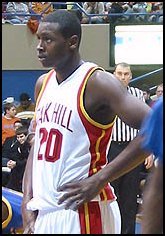
Julian Vaughn stands 6-foot-8, boasts a high GPA and is ready to enter one of America's most prestigious basketball factories -- Virginia's Oak Hill Academy.

Nobody, not even the NCAA, can convince Vaughn he's making a mistake.

Even after Oak Hill was placed last week on the list of 22 schools that will have its academic standards under review by the NCAA, Vaughn still intends to enroll there this fall.

"Even if it was on the list of offenders, I'd still want to go," he said. "I have a 3.7 GPA, so I'm really just going there to get my last few credits."

Of course, there's the added attraction of playing basketball for an institution that annually produces some of college basketball's premier prospects. Vaughn hopes to carry on Oak Hill's legacy.

The questions being asked now, though, are more about academics than talent.

Ever since The New York Times exposed University High in Miami, a correspondence school that offered diplomas to students despite having no classes nor instructors and operating almost without supervision, the NCAA has been scrutinizing the standards of nontraditional high schools to identify "diploma mills."

The NCAA has been looking for irregularities such as one-year students, dramatic academic improvements or uncharacteristic classwork patterns.

Jeff Allen, a former Oak Hill player who is transferring to Hargrave Military Academy this fall, appears to fit the model. In one year at Oak Hill, Allen said he made progress academically and fulfilled five core courses toward his college eligibility.

"It was an academic decision," he said, referring to his former school. "It took one year, and it was hard at first. But once I got used to it, it became easier."

There is a risk: Students attending listed schools could lose their freshman eligibility.

NCAA vice president Kevin Lennon said transcripts will continue to be evaluated individually and that students at the listed schools could retain their eligibility if their records show a pattern of academic achievement.

By publicizing the lists, NCAA officials hoped some athletes would reconsider their choices. The early returns are not encouraging.

On Wednesday, 16 schools were added to the list of offenders -- seven of them from Santa Ana, Calif. Twenty-two others, including Oak Hill, face more review over the next year.

And when Vaughn arrived at the Nike All-America Camp on Thursday, he wasn't even aware Oak Hill made the list.

"I didn't hear about it, no," he said. "People can say whatever they want to say, but I've not heard anything bad about their academics. I know a lot of people hate the fact they have a rich basketball tradition, so they'll say whatever they want."

Vaughn isn't the only one with concerns about the NCAA's crackdown.

Syracuse coach Jim Boeheim, winner of the 2003 national championship and a prominent member of the National Association of Basketball Coaches, is questioning the process.

He wondered why one school, which he declined to identify, made the list even though it has an enrollment of 300, a principal and a faculty. He also believes the NCAA's new mission poses a dangerous potential for expansion.

"The next thing they're going to do is look at inner-city schools, and we're not supposed to take those kids because it's a bad high school," he said. "Where are we going with this?"

Lennon insisted that would not happen.

Instead, he said the NCAA is looking more closely at schools that do not fall under state oversight, and that if investigators found irregularities at public institutions, the NCAA would notify that state's regulating body.

"Every student will have his records reviewed by the clearinghouse," Lennon said. "What we're trying to do is pick out kids who have miraculous recoveries in their last year. That's the kid that needs to be concerned."

The schools that have been identified span the continent, from North Atlantic Regional in Lewiston, Maine, to Hanna Boys Center in Sonoma, Calif.

Some administrators were surprised to learn of their inclusion. Lt. Gen. John E. Jackson Jr., president of Fork Union Military Academy in Virginia, said NCAA officials have neither visited the campus nor expressed specific concerns about the curriculum.

But one common factor is the number of prep schools and Christian schools listed.

"One of the reasons for that is that they are not regulated by state agencies," Lennon said. "You don't see any public schools on the list because they are regulated, so when you have Christian schools or prep schools that aren't regulated, they're more likely to make the list."

Regardless, the risk of losing a year of eligibility does not appear to be changing minds yet.

"I heard a rumor that a lot of kids go down there to qualify, but I don't really know how the academics are there," Vaughn said. "I know the teachers live on campus, like in a dorm, and they give you extra help. I think if a teacher is right there, it would help you a lot."

By Michael Marot
The Associated Press

Thursday, July 13, 2006

Afghanistan: Pfc Justin Davis

photo courtesy of Marketa Ebert

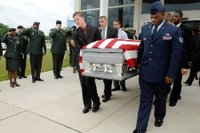
As an honor guard performed the burial of Army Pfc. Justin Davis, his mother Paula could not help but think that this is what her son would have wanted.

"He always wanted to be a hero," said Paula Davis. Friends and family say Justin was certainly that as he was laid to rest at Arlington National Cemetery in front of more than 100 friends and family Monday.

Justin, a 2005 graduate of Magruder High School, died June 25 while on patrol with the 10th Mountain Division in the Korengal Outpost in the eastern Kunar province in Afghanistan, where he had been since March. He was awarded the Purple Heart for being wounded in battle and a Bronze Star, both of which were given to his family Monday.

Before the burial at Arlington, close to 600 people attended Justin's funeral service at the Interdenominational Church of God in Gaithersburg Saturday. Almost every speaker called Justin a hero.

"Justin did something most people won't do," said Pastor Randy Dennis of Lakewood Church of God in Germantown. "He went off to fight and die for our country."

As Joseph "Jo-Jo" Holland started to speak, he took a step back to collect himself and was immediately consoled by several members of the crowd. Holland talked about plans he and Davis had made to go to Los Angeles after graduation to pursue acting careers.

"I'm out there now, doing it for him," Holland said. "He's a cool dude, and I love him."

Pastor Leon Grant of Mt. Calvary Baptist Church in Rockville, where Justin was an active member, said, "Justin was a hero to us all, and his was not in vain."

Barry Moultrie, a family friend who said that Justin was "like a surrogate son," said that while Justin did not die in vain, his should give policymakers in Washington pause to consider bringing the rest our kids home to prevent further needless loss of life.

Justin's is under investigation by the military as a possible friendly fire incident. Army Spokesman Maj. Nathan Banks said Davis was killed by "indirect fire," which is a term often used for mortar attacks, but no other information has been released. So far 17 soldiers have died in Afghanistan and Iraq due to friendly fire.

Paula said that no matter how her son died, the circumstances of Justin's are not important to her. What matters, she said, is that Justin was destined to be a soldier, and he was able to fulfill that destiny.

"You could see it when he was a little boy," said Paula. "He was always intrigued with action figures, GI Joes, that kind of thing."

Justin's interest in the military peaked when he attended Hargrave Military Academy in Chatham, Va., during his junior year of high school, where many of his teachers were retired officers. When Justin came back to Magruder for his senior year, it was clear to everyone that he had made up his mind to join the military.

"He was always adamant about joining the armed forces and serving his country, but when he came back from Hargrave, you could see the difference in him," said Ed Ashwell, Justin's football coach at Magruder. "He went from being a boy to being a man, saying 'Yes sir, yes ma'am,' those kinds of things. It fit him to a T."

Paula said she tried to convince her son not to join the military because of the conflict in the Middle East, but she said Justin would not be dissuaded.

"He was my only son," she said, " and I reminded him of that. You know what he told me? 'Mom, you should have had more kids.'"

Paula was adamant about Justin going to college and said she always made sure Justin knew he had options.

"He knew that if I had to work three jobs I would have done it, and that he didn't have to go into the military," she said. "But he told me, 'Mom, I still want to go to college, I just have to do this first.'"

She remembers one night in particular when Justin made her sit down with him and watch a show on television about the Army Rangers.

"I went out and bought him an Army Rangers shirt the next day, and he was wearing that to school, around the neighborhood, and even when he was working out trying to get his weight down for basic training," Paula said. "I knew I had to let him go and give him my blessing. I could have begged him to stay, and he probably would have."

"I asked him once, 'Why don't you just wait a little bit?' He said, 'Wait for what, mom, I have to get on with my life,'" she said.

Justin was assigned to Fort Drum, N.Y., after graduation, where he was a member of the Alpha Company of the 1st Battalion, 32nd Infantry Regiment, 10th Mountain Division. When his unit was assigned to Afghanistan, Justin was excited to go.

"He felt like this was his calling, that he could do some good," said Paula. "This encompassed everything that he was, from his young days playing with GI Joes up through Hargrave and his last year at Magruder. It was who he was."

"He died doing what he wanted to do," said Ashwell. "How many of us are going to be able to say that?"

By Josh Bowman
Montgomery County Sentinel

Wednesday, July 12, 2006

Free speech is strangled

Nearby Hargrave Military Academy and a pair of disgruntled parents settled a lawsuit this week, but nothing was settled about the court’s “right” to interfere with free speech.

Jerry and Melissa Guyles had started a Web site complaining about the academy’s decision to expel their son after the Honor Council found him guilty of stealing.

Hargrave President Wheeler M. Baker affirmed the decision.

The couple claimed that Hargrave “suffers from poor leadership due to their President, Wheeler Baker.” They also posted a letter they sent to other Hargrave parents saying Mr. Baker lacked professionalism and integrity.

Details of this week’s court settlement are secret, but the Web site was not back up and working.

Hargrave and Mr. Baker sued the Guyleses, claiming, among other things, that they launched their allegations with “reckless disregard for the truth.”

The resulting civil trial would have proved whether Hargrave and its president were right, or whether the Guyleses were justified in their criticism.

It should have been a straightforward case of cause and effect. The law requires each of us to take responsibility for what we say or write, post or broadcast.

If the Guyleses made a mistake, they would have to bear the consequences. That should have been decided at civil trial.

The problem is that a judge took the Web site offline before hearing all evidence. That’s called “prior restraint,” and it violates fundamental and long-established precedents in First Amendment cases.

Two issues are at stake: that the judge exercised prior restraint, before hearing all the evidence, and that he imposed an overly harsh penalty.

The Thomas Jefferson Center for the Protection of Free Expression, based in Charlottesville, and the American Civil Liberties Union of Virginia joined to argue against the censorship. They said the judge’s restraining order violated free speech when it was issued in May because it came before the parents had a chance to argue their side of the case.

“The court’s order is extraordinary, a bad sign of our times,” said Kent Willis, executive director of the Virginia ACLU. “Our freedom depends first and foremost on free speech. Judges are allowed to curb speech only as a last resort and then under the most carefully and narrowly controlled circumstances.

“Wiping out an entire Web site because one party doesn’t like what it says simply does not comport with our understanding of free expression in this country.”

“Wiping out an entire Web site” is the other half of the problem. Not only did the judge impose prior restraint, but he employed a draconian method of overkill.

After all, it wasn’t the Web site itself that was the alleged problem, it was the disputed words on the Web site.

If this sounds like nitpicking, consider long-time precedent. Even if a publisher or broadcaster is found liable for reckless disregard in one of its stories, the newspaper, magazine, radio or TV station is not ordered to shut down. There are responsibilities, there are consequences, there are penalties to face, but the publisher or broadcaster may continue to operate.

This precedent is such a well-established feature of First Amendment law that its violation is especially shocking. It is indeed a bad sign for our times.

There’s a reason our Founding Fathers put free speech (and freedom of religion) first in their list of protections. Democracy can’t exist without freedom of speech. We must be able to criticize those in authority. The Founders knew that even if the criticism was wrong, even if it were reckless, the risk was worth the benefits.

The Charlottesville Daily Progress

Tuesday, July 11, 2006

The first 50 years

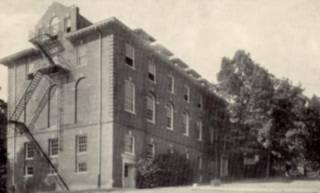
Camden Hall in the 1940s

Dr. T. Ryland Sanford (my grandfather) had the idea for a private school in Chatham, VA. As the pastor of the Chatham Baptist Church, he had little money, but an active idea. Mr. J. Hunt Hargrave, was a well-to-do local tobacco farmer, who lived in a large house near the church, on the northeast side of the road to "Whittletown." Mr. Hargrave was agreeable to investing some money in the idea, and thus Chatham Training School (CTS) was born in 1909.

My grandfather was president from the founding until Aubrey H. Camden became the second president in about 1920 (I am not positive of the year). Col. Camden held the job until 1950. When I came back to Hargrave to discuss my becoming a cadet, it was with Col. Camden in the spring of 1949. Col. Cosby took over in the fall of 1950, and was responsible for guiding the school through the process of rebuilding after the fire of 1950.

During the period that Dr. Sanford was president, a large "President's House" was built from a Sears & Roebuck kit on a site at approximately where the Cheatham Chapel now stands. Dr. Sanford's daughter, Eleanor (my aunt) was the first woman to attend Hargrave, as a day student living in the President's House. The Sears Kit house was used as the President's House until well into the 50's (or later).

Several of my uncles attended Hargrave (or CTS) and upon my father's graduation from the University of Richmond in 1929, he became the Athletic Director at Hargrave and Head Coach for everything for the next 13 years. I was born in Danville, and grew up on the campus of Hargrave until 1942, when my father became Athletic Director at Randolph-Macon in Ashland, VA. We lived in apartments in the Junior Department and the third floor of Sanford Hall, a big house which still sits on Main Street, and a school-owned house down in the "bottom" adjacent to the house built by Mr. Bell - the Head of Maintenance. My mother taught Math and English in the Junior School for several years.

It was while I was a cadet in 1950, that we had the big fire (it began during study hall, in a second floor area immediately below my room over what is now the Main Entrance - as it was then). That cold February 20th night, most of us lost everything we owned - most evacuated in our shirts, without the thought of grabbing a coat. Initially, everyone just thought is was "drill," but the size and speed of the fire made it impossible to go back and get much, if anything.
The Chatham townspeople really did themselves proud in the way they collected displaced cadets and took them to their homes to a nice bed, and gave them some warm clothes and a good breakfast the next morning. Almost everyone in Chatham mobilized to help. Many of us stayed with townspeople for several days until the school was officially closed for a period, and we were sent home. I don't remember exactly how long it was before we returned to occupy doubled up dormitories and the use of every available space to house cadets. Nonetheless, we finished the school year, had graduation in the auditorium in Sanford Hall, and during the summer, much work was done to rebuild the campus.

In fighting the fire, the Chatham water supply was pretty much exhausted, and the firefighters parked one or more pumper trucks down beside the swimming pool in the bottom, inside the circular drive, and pretty much pumped it dry, it being the only available water supply. Hargrave could very easily have died that night. Col. Cosby became the next president, and refused to let Hargrave die. He did wonders at raising money and getting assistance. I was in college at Wake Forest and not involved directly, but remained very aware of what was happening.

Taylor H. Sanford, Jr.
thsjr@juno.com
Class of '50